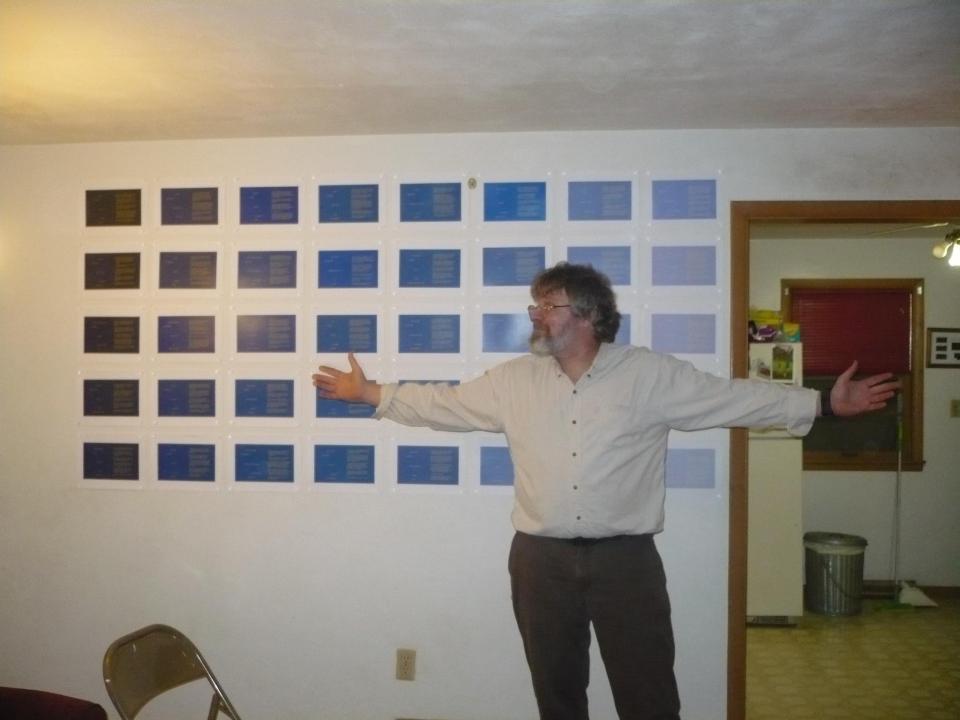
50 Easy Pieces was written in the months preceding my 50th birthday. I wrote 50 scenes on colored swatches of people and events I have encountered. The swatches started deep blue and gradually transformed to bright yellow (the blue portion is depicted above).
I composed each by laying out lines in open form, meditating on them, then finishing the contemplation with a prose poem.
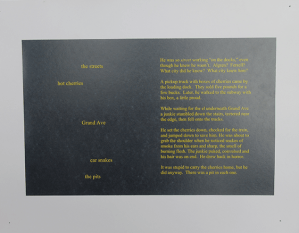
He was so street working “on
the docks,” even though he
knew he wasn’t.  Algren?
Ferrell?  What city did
he know?  What city knew him?

A pickup truck with boxes of
cherries came by the loading
dock. They sold five pounds
for a few bucks. Later, he
walked to the subway with
his box, a little too proud.

While waiting for the el
underneath Grand Ave a
junkie stumbled down the
stairs, teetered near the
edge, then fell onto
the tracks.

He set the cherries down,
checked for the train, and
jumped down to save him. He
was about to grab the
shoulder when he noticed
snakes of smoke from the
ears and sharp, the smell
of burning flesh. The junkie
puked, convulsed and his
hair was on end.  He drew
back in horror.

It was stupid to carry the
cherries home, but he did
anyway.  There was a pit
in each one.
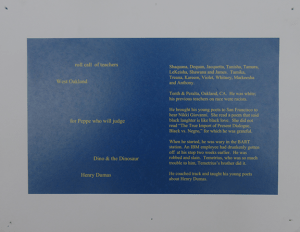
Shaquana, Dequan, Jacquetta,
Tanisha, Tamara, LeKeisha,
Shawana and James. Tamika,
Treana, Kareem, Violet,
Whitney, Markeesha and
Anthony.

Tenth & Peralta, Oakland,
CA. He was white; his
previous teachers on race
were racists.

He brought his young poets
to San Francisco to hear
Nikki Giovanni. She read a
poem that said black laughter
is like black love. She did
not read “The True Import of
Present Dialogue, Black vs.
Negro,” for which he was
grateful.

When he started, he was wary
in the BART station. A drunk
IBM employee had mistakingly
gotten off at the stop two
weeks earlier. He was robbed
and slain. Temetrius, who
was so much trouble to him,
Temetrius’s brother did it.

He coached track and taught
his young poets about
Henry Dumas.
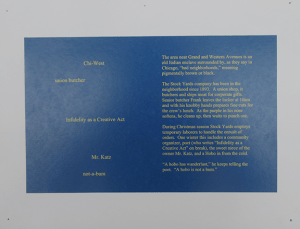
The area near Grand and
Western Avenues is an old
Italian enclave surrounded
by, as they say in Chicago,
“bad neighborhoods,” meaning
pigmentally brown or black.

The Stock Yards company has
been in the neighborhood
since 1893.  A union shop,
it butchers and ships meat
for corporate gifts.  Senior
butcher Frank leaves the
locker at 10am and with his
knobby hands prepares fine
cuts for the crew’s lunch.
As the purple in his nose
softens, he cleans up, then
waits to punch out.

During Christmas season Stock
Yards employs temporary
laborers to handle the onrush
of orders.

One winter this includes a
community organizer, poet
(who writes “Infidelity as a
Creative Act” on break), the
sweet niece of the owner
Mr. Katz, and a hobo in from
the cold.

“A hobo has wanderlust,” he
keeps telling the poet.
“A hobo is not a bum.”
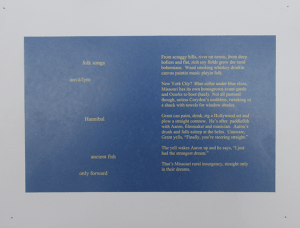
From scraggy hills, river
rat towns, from deep hollers
and flat, rich soy fields
grow the rural bohemians.
Weed smoking whiskey
drinkin canvas paintin
music playin folk.

New York City? Blue collar
under blue skies, Missouri
has its own homegrown
avant-garde and Ozarks
to boot (heel).

Not all pastoral though,
unless Corydon’s toothless,
tweaking in a shack with
towels for window shades.

Grant can paint, drink, rig
a Hollywood set and plow a
straight cornrow. He’s after
paddlefish with Aaron,
filmmaker and musician.

Aaron’s drunk and falls
asleep at the helm. Unaware,
Grant yells, “Finally,
you’re steering straight.”

The yell wakes Aaron up and
he says, “I just had the
strangest dream.”

That’s Missouri rural
insurgency, straight only
in dreams.
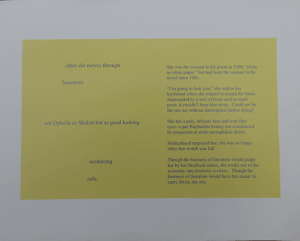
She was the woman in the
poem in 1990, “clean as
white paper,” but had been
the woman in the novel since
1961.

“I’m going to beat you,”
she said to her boyfriend
when she wanted to pound
the futon.

Surrounded by a trail of
boric acid to repel pests,
it couldn’t keep him away.
Could sex be the one act
without interruption
before dying?

She has a pale, delicate
face and wan blue eyes--
a pre-Raphaelite beauty
not constructed by
projection or male
necrophiliac desire.

Motherhood surprised her;
she was so happy when her
womb was full.

Though the business of
literature would judge her
by her facebook status, she
works out of the economy
into feminine ecriture.
Though the business of
literature would have her
manic to curry favor,
she sits.
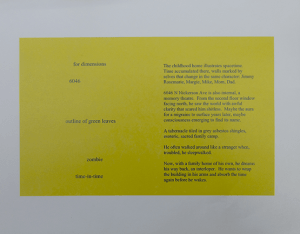
The childhood home
illustrates spacetime. Time
accumulated there, walls
marked by selves that
change in the same character:
Jimmy, Rosemarie, Margie,
Mike, Mom, Dad.

6046 N Nickerson Ave is also
internal, a memory theatre.

From the second floor
window facing north, he saw
the world with awful clarity
that scared him shitless.
Maybe the aura for a
migraine to surface years
later, maybe consciousness
emerging to find its name.

A tabernacle tiled in grey
asbestos shingles, esoteric,
sacred family camp.

He often walked around like
a stranger when, troubled,
he sleepwalked.

Now, with a family home of
his own, he dreams his way
back, an interloper. He
wants to wrap the building
in his arms and absorb the
time again before he wakes.
 Mike Barrett Archive